“I choked/ on such longing I couldn’t spit out. Yes, desire is so different/ when God bore you hungry.”
–anonymous
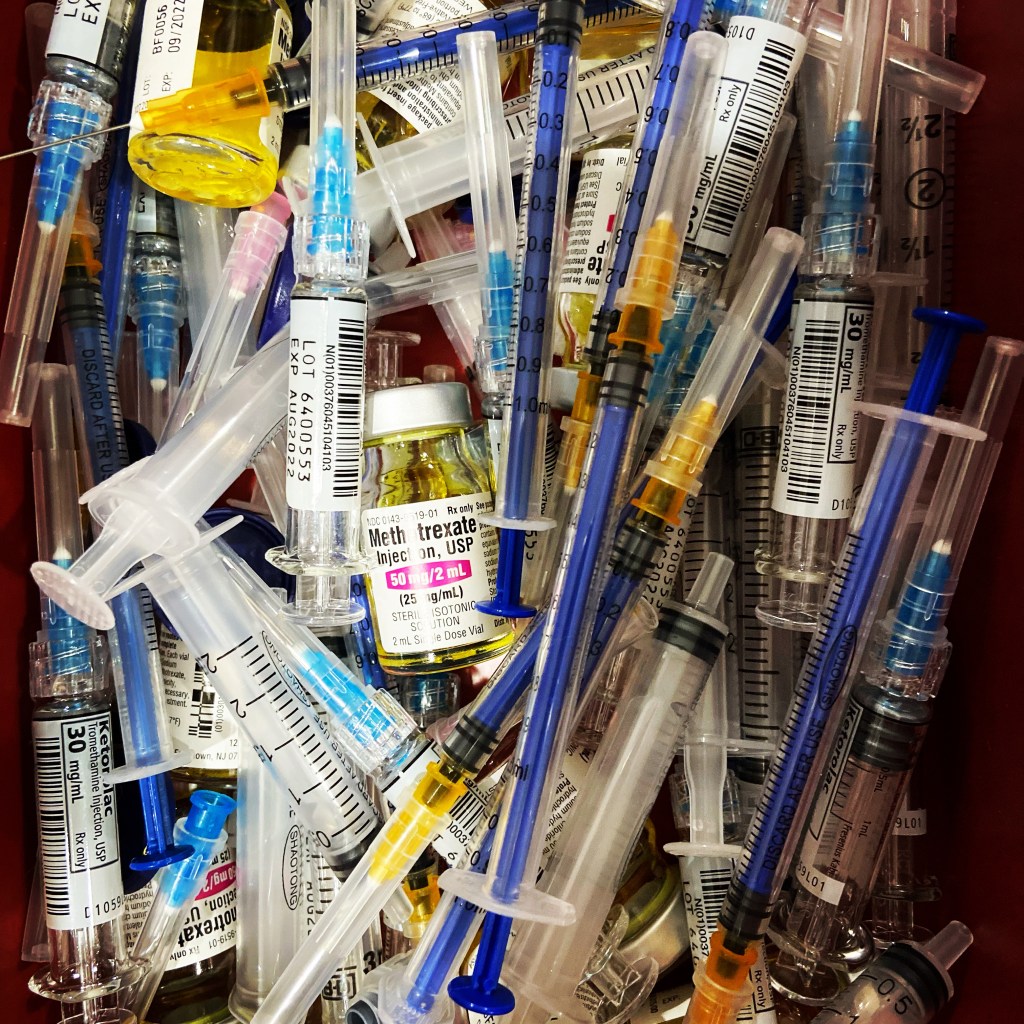
My skeleton lights up like a Lite-Brite at night when I’m trying my hardest to sleep. There are over 400 bones in the human body and I can feel every one of mine. Pain always has friends however, and some of them can be sinister, so when it’s incandescent I trek towards the night nurses at my local hospital.
“Hey, it’s nice to see you again,” Nick says as he collects me from the waiting room. I’m an easy patient with less easy veins. I’ve been attached to an IV pole so many times that I’m losing my luster.
Nick putters around my bed recalling details about my veins and my diagnoses and my bones I struggle to articulate. He slips an IV in on the first try and starts the medications slowly so I don’t get a rushing feeling sending me straight into the floor. We love a nurse who dilutes.
He comes back every half-hour on the dot with medication, “I went ahead and brought this because I knew you’d need it. Usually takes more than one to knock it out.” The slow rush of warmth from the medication hits again, and half an hour later, once more (with feeling).
It’s a long night of the soul, but there’s also Nick at night.
Chiquitita, you and I know How the heartaches come and they go and the scars they’re leavin’ You’ll be dancing once again and the pain will end You would have no time for grievin’1
Hesed is Hebrew for grace, and one of the few words in my Hebrew vocabulary that I can actually remember. (It’s a pretty good one to remember). Hesed implies more than just unconditional divine love, or even God’s love for God’s beloved. It connotes a covenantal relationship: you give, I will give.Hesed is also active: it shows care, it shows up, it is compassionate and it follows through.
We can see this kind of love in our relationships with our divine, but we can also see it in human relationship, and our relationship with other beings in our life. I’ve never seen Hesed better expressed than in my friendship with my best friend Gracie. (aptly named).
We started getting to know one another going on coffee walks with our dogs. Then we started “Grandma Nights” where we watched some trash television, knitted, and wore our matching slippers while eating Girl Dinner™. We bonded over being care professionals, dog parents, and young people in an increasingly bereft world. Eventually those get-togethers transformed into emergency contacts, hospital companionship, deep therapeutic conversations, and support through The Loss Years when everyone else seemed to fall away. Gracie quickly became the standard for the care I should expect from a friend, or anyone I was in relationship with.
Driving on the highway to visit Gracie and her dog Lizard this October, I was reflecting on how grateful I was for this Hesed. How remarkable a note on the community board of an apartment building turned into someone becoming my North Star.
It was my undergrad faculty advisor and mentor (h/t to Dr. Colleen Windham-Hughes) that introduced me to the idea of our relationships of support being members of a constellation. The constellation model allowed for different relationships to have different roles, different intensities, and different levels of intimacy. Different roles (or stars) shine at different times. The constellation model also allows for change, rotation, and shift. No one person is bearing the load of being the be-all end-all. A constellation in rotation, if you will. Gracie has long been my North Star, guiding the constellation as a whole.
Hesed means grace, and she surely lives up to their name.
Given at Bonnie’s Celebration of Life, September 28th, 2025
My name is Mollie Mae, and I am Bonnie’s niece. I am a reverend (an irreverent one!), a chaplain, and a clinical crisis counselor on our suicide crisis lines. Five years ago when I left the home of my abusive parents with my car packed with books, my dog, and a handful of essentials, my Aunt Bono was the first of my family to reach out with love and acceptance from both her and Aunt Mary. While we weren’t able to fulfill our dreams of visits and trips together due to the covid landscape and our own chronic conditions, we bonded deeply over the phone and sharing our lives over the internet. I still reach for the phone thinking “I gotta tell Aunt Bonnie this!”.
I have scoured poetry, devoured books, and listened to lyricists that put proper words to grief and loss. But there’s no words for Aunt Bono no longer being on the other side of the line in her lounge chair. No one calls me and says “Hi cutie!”, and sadly, no one butt-dials me anymore, either. The grief is deep, because the gift she gave was vast. As our mutually beloved Dolly Parton once said, “laughter through tears is my favorite emotion.” And as Sally Field said in the same film, “I wanna know why!” There’s a hole in the my world without her here.
We shared a love for terriers, Steel Magnolias, true crime documentaries, weekend phone calls, and Winninger family lore. She taught me all about my namesake Grandma Mollie, and we planned for her to be the flower girl at my wedding one day. We drove the same exact car, both had ADHD, and were notoriously late when it came to sending things in the post. She generously shared her life and loves with me. She was my champion, confidant, and the family member who loved me most. I will miss her humor, her guidance, and her deep compassion for the world and her constellation of loved ones. For all intents and purposes, she should have been my mom because we were kindred spirits in the truest sense. She taught me what having a best friend really means- what it means to have community, acceptance, belonging- while living in your authenticity.
I’d like to provide a blessing for those gathered here that loved Bonnie as fiercely as I did. Aunt Bono was a bit of a recovering Catholic, but deeply spiritual, and asked me before she died to do something to honor her spiritually. I was able to record final prayers for her and while I’ve had the privilege to do many things as a reverend, there is no greater privilege than fulfilling someone’s final wishes, not to mention your best friend.
A blessing for Bonnie and those that loved her:
Blessed is the lesbian who was called to show care, Blessed is the friend who sits vigil in a hard hospital chair. Blessed is the diet soda pop, the kindred spirits, and the 3am messages over the laptop.
God bless the storytellers, the cackles through tears, the funeral hams, and inside jokes through the years. God bless us here, kith and kin.
God go before us, God go after us. God meet us at the door. God be beside us, God be within us, Ancestors hold us, and answer our call.
Adapted and inspired by Mark Aguhar’s “Hymns to My Heavenly Brown Body”.
Should anyone be interested in music to accompany this little liturgy, this page has short links to a playlist inspired by Bonnie. There is a version both for Spotify and Apple Music, depending on what you use. Go with grace and peace- you are beloved.
The story of the “bleeding woman” is found in more than one gospel and is a familiar narrative to many of us that grew up “well churched”. Feel free to read this retelling in NIV below to refresh yourself.
25 a woman was there who had been subject to bleeding for twelve years. 26 She had suffered a great deal under the care of many doctors and had spent all she had, yet instead of getting better she grew worse. 27 When she heard about Jesus, she came up behind him in the crowd and touched his cloak, 28 because she thought, “If I just touch his clothes, I will be healed.” 29 Immediately her bleeding stopped and she felt in her body that she was freed from her suffering.
30 At once Jesus realized that power had gone out from him. He turned around in the crowd and asked, “Who touched my clothes?”
31 “You see the people crowding against you,” his disciples answered, “and yet you can ask, ‘Who touched me?’ ”
32 But Jesus kept looking around to see who had done it. 33 Then the woman, knowing what had happened to her, came and fell at his feet and, trembling with fear, told him the whole truth. 34 He said to her, “Daughter, your faith has healed you. Go in peace and be freed from your suffering.”1
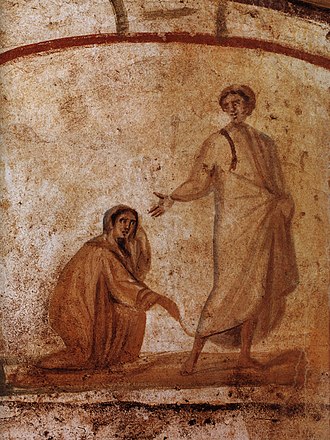
Jesus and the Bleeding Woman, found in the catacombs of Marcellinus and Peter.
I’ve heard everything about the “bleeding woman” from being a bastion of bravery for touching the cloak, to being selfish and taking up Jesus’ time. She has, in history, been called also “the audacious woman”. Audacious indeed.
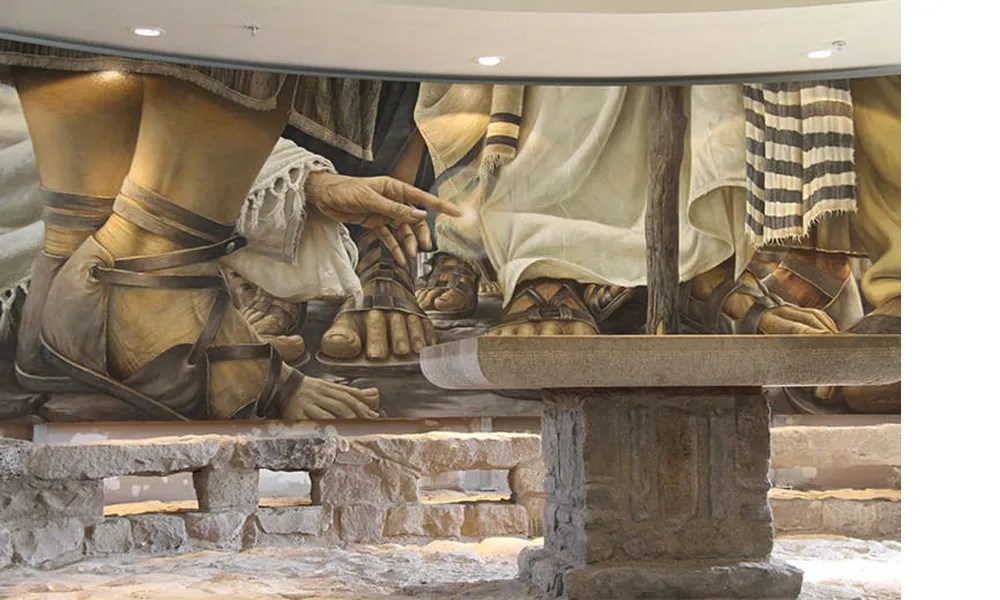
I put her moniker in quotations because the missing piece we need in interpreting her story is that she likely had endometriosis.2 There are many3 scholars who have extrapolated what was happening in the unnamed woman’s body. She likely wasn’t just bleeding, she was experiencing pain. What the story seems to emphasize is that her faith, or pistis, (which connotes perseverance and persistence as well as faith), led her to someone who could alleviate her suffering, her pain.
For twelve years she had tried whatever physician she could afford, with no yield of relief. She was still suffering twelve years later. People call her “audacious” because she interrupts Jesus, and takes what she can (according to this NIV account where Jesus describes the power going out of him.) She appears to receive healing that ends her pain, and is praised for her faith and audacity. It reminds me of the verse in Malachi that challenges us to test God, and let God pour out the blessings upon us.4
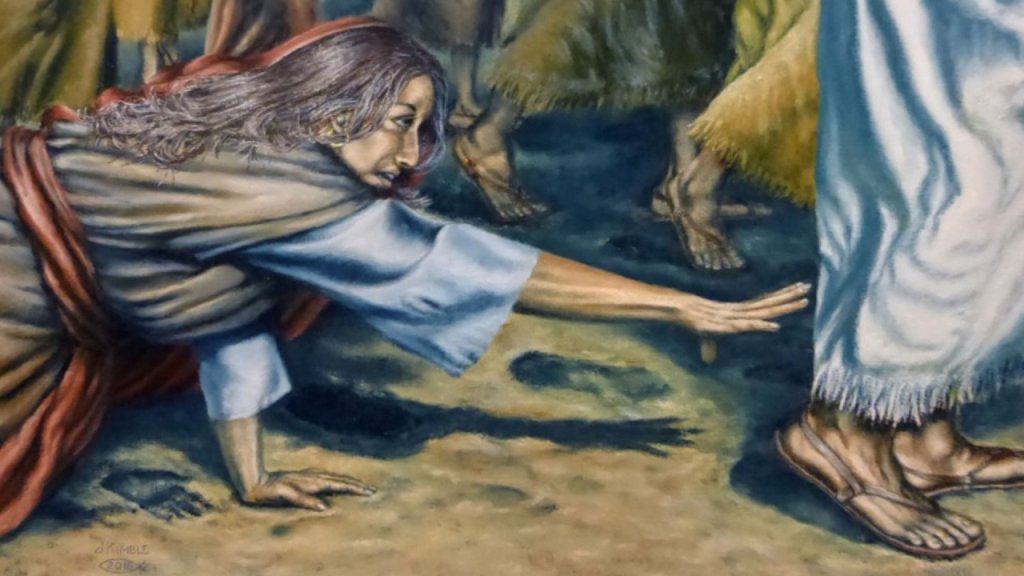
“The Encounter Between Jesus and the Haemorrhaging Woman”, by Daniel Cariola. Oil on canvas. 1998. The Encounter Chapel, Magdala.
But let us not be misled by the fact that she no longer experienced pain! Never forget the persistence and utter desperation it took to touch the coat of a folk healer; at your wits’ end. I could talk about the power of human:human touch on a body that only ever gets touched clinically. I could easily go into deeper context about Greco-Roman views on bodily fluids, healing, and embodiment, but we can all relate to the human experience of desperation. Of trying one last time.
Of course, fixing of a chronic condition or disability was not the goal of Jesus. We know Jesus healed because he wanted to restore community members back to the community. Just like Jairus, his wife, and his daughter’s narrative are woven throughout this story, they unite in the goal of restorative disability justice. All the women at different stages of their life were entitled not only to restoration in the community, but their purpose and vocation. It is recorded that Jairus’ wife also held an important leadership role in the synagogue, so what did the Audacious Woman do where she was economically independent and funding her own healthcare? What was her vocation before pain intervened?5
What did you do before pain intervened?
In bereavement, there is a model called the Grief/Restoration model.6 The model states that we bounce between states of restoration and then grief, inevitably, for indiscriminate amounts of time. We could be in the restoration side trying to cultivate new things for years, months, weeks, days, hours, minutes. And the same if true for the grief phase.
I would argue that touching the cloak of Jesus brought the Audacious Woman back into the restoration phase of her life. The world and community was open to her when she no longer was experiencing chronic pain.
Does this mean that we should fix chronic pain? Or emotional pain even?
No. It doesn’t.
Grief is as essential as restoration. Both should lead us to community. Whether or not the restoration includes the end of suffering or pain. How we carry that grief, and carry it with others, matters. Transformation: optional. Transformation? Highly recommended.
I recently was online and saw a tee shirt imprinted with a quotation from hymnody reading “it is well with my soul!” And I thought to myself, “it is not well with my soul right now.” After breaking up with my partner of four years, losing my best friend and aunt, my grandfather a week later, and going through an arthritis infusion switch, I was very unwell indeed.
What happens when we answer the question how are you? with honesty? What happens when it is not well with our souls? When we are living in Lamentations? What is the antidote to a hurting soul and heart in a trite and disingenuine world?
I had a co-worker ask me if I enjoyed my bereavement leave and I answered a little too honestly. We grant people a weird death vacation, and then expect them to return back to normal in bodymind, ready to be productive to the system, be useful to us, and no longer inconvenient grievers feeling feelings that cause others discomfort.
I’m sorry for your loss.
If we were only able to sit in the discomfort for a moment with somebody else, maybe we could stitch a soul just a tiny bit. Maybe we could sense the gravity of someone who lost the rest of their family in a mere month. Maybe we could steady someone who’s heart is quivering, trying to make it.
As someone who has now experienced eight losses in two years, I wish I had something mystical and profound to say about grief or healing or seasons. Something lyrical and mending. All I have found is that life goes on without them, and Lamentations 1:20 feels viscerally true when it says: “See, LORD, how distressed I am! I am in torment within, and in my heart I am disturbed, for I have been most rebellious. Outside, the sword bereaves; inside, there is only death.” Being surrounded by death, having death cover your house is a very real, palpable feeling. Rebelling to me doesn’t mean acting out or doing something incorrectly, but feeling wildly, and bigl-ly.
Nicholas Wolterstorff is onto something in his writings when he describes grief as sitting on a mourning bench alone. When we invite our divinity figure, they can sit there next to us on the mourning bench, so we are no longer alone. When we look at this kind of incarnational relationship, we see a God(dess) who seeks to intimately know us in our pain, who is also bereaved for us, who feels deeply. Some scholars call this divine omnisubjectivity, or put simply “omni-empathy”- perfect divine empathy. We are not meant to mourn alone, but in community. Even a pair is community.
Every time I remember them again, I lose them again, I invite God to sit with me on the bench. Every time I cry in the car, God cries next to me. When I rage, Christ rages beside me. My soul is not well, and that is fine with God.
Well I no longer hear the music when the lights go out,
Love goes cold in the shades of doubt.
The strange fate in my mind is all too clear.
Music when the lights come on,
The girl I thought I knew has gone
And with her my heart had disappeared.
– Coeur de Pirate
We walked around the building in a long loop, and I held her like a baby. She never wanted to be held like that until she was dying. She had her eyes shut, the breeze licking her face. She was soaking up the sunset and the sway of our walk, occasionally peeping an eye open to see where we were and to sniff the air. I had built a tiny hospice for her in our home, keeping her comfortable and deeply sedated; preparing myself to walk her Home soon. My insides couldn’t bear the thought of loving her so much and never being in the same room as her again.
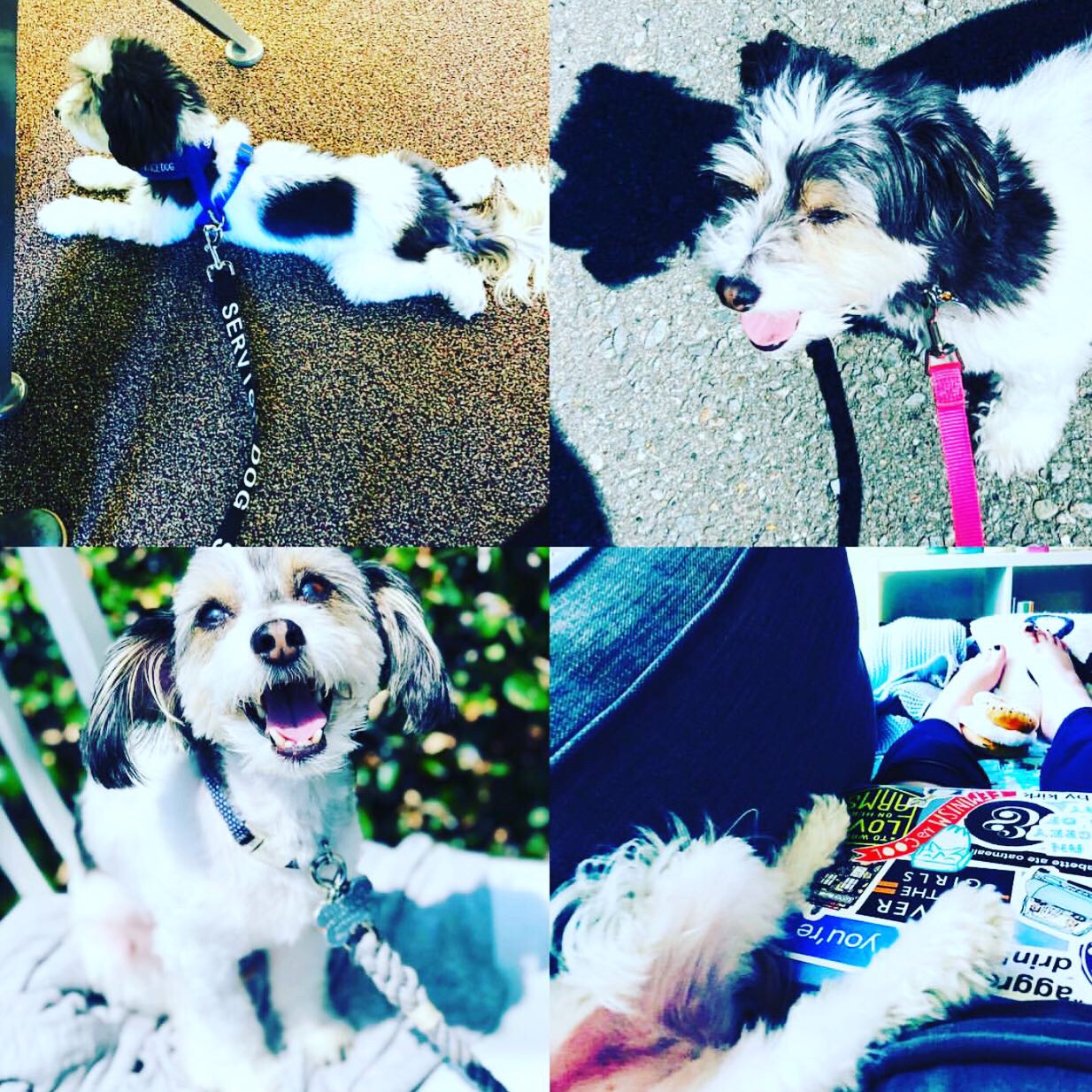
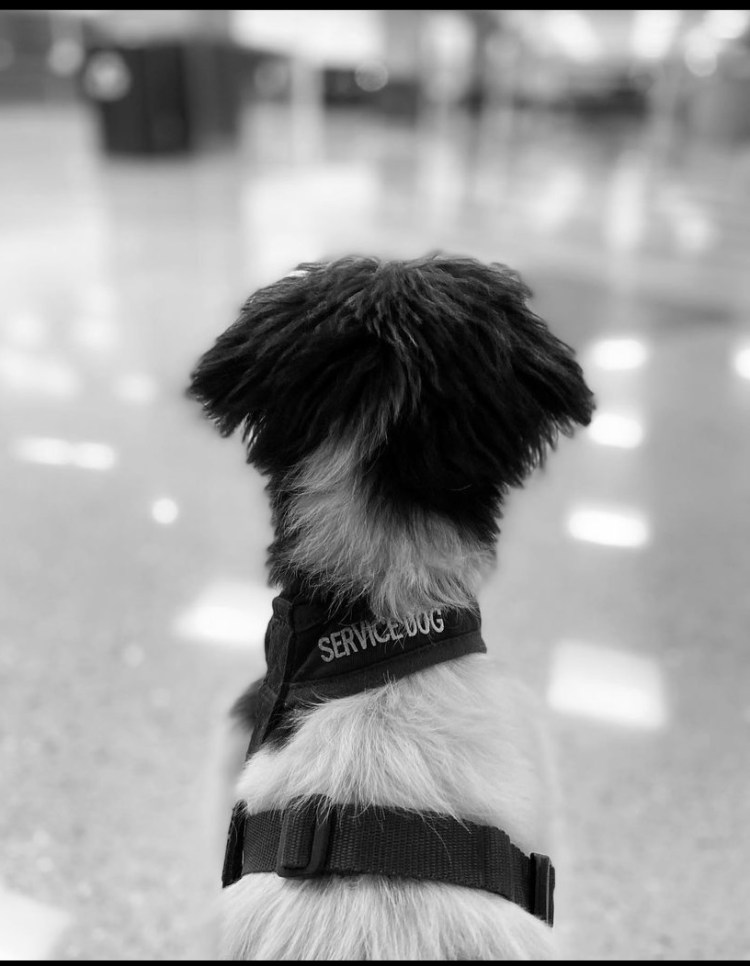
Bailey was a sunbeam. She wasn’t just a service dog. As if a service dog could ever be “just” the lifesaving love they encompass. She had a snaggletooth, no top teeth, and a grin to end all grins. She expressed her happiness with twirling and the occasional whine, especially as we pulled into her favorite place to work (Target). She loved chicken, burrowing in blankets, sleeping spine-to-spine with her human, and getting acquainted with elderly people. NASA was her nirvana, where old folks abounded. She had to say hi to each one, even though it wasn’t “professional”. When she witnessed an older woman take a fall, she was the first to abandon her perch and kiss the injured hand of the person she wanted to help. She’d snack with you, snuggle in tight spaces, and hide in your laundry basket. Can’t find Bailey? Call her name and she’d wiggle out from a piece of furniture, or jingle her way toward you, belly wet from sleeping in the shower.
Now she was gone in an instant.
It was the long, dark night of my soul.
It didn’t matter that I helped people die for a living as a chaplain, I was afraid that I wouldn’t know how to help my best friend die. I watched my patients sundowning, bearing the burden of dementia and anxiety and recognized it when Bai started to do the same. I carried her her whole life, and I would carry her as she drifted out of this one into the next. She saved me more than once, and I saved her more than once.
Bailey was released into the night sky on a Saturday Summer night when she told me it was time to let her go. I still find bits of her foxtail collection around the house like glints from the afterlife. I’ve cried in the car most days going to work thinking about her and all the goodbyes we have to say and shouldn’t.
As I told my patient this morning, “I know.” It’s not my first loss, but it’s certainly my most incandescent.
I loved her enough to let her go. But my life was bereft without her. I lost part of my heart that night when Bailey died. My best friend helped me usher my other best friend into the afterlife. I wrapped her in the fleece after her spirit left her tiny body and as I held that bundle I cried sobs that were the ugliest, gut-wrenching cries of why. I was not crying alone. She wasn’t loved by only me.
A year on, she is markedly absent from the spaces she filled. Sometimes I swear I can hear the jingle of her collar, or a little sigh or huff. I walk around corners expecting to see her, my bed lies empty, and her flower blanket remains, but she is gone. There is so much permanency in gone.
I wrote about her regularly in a journal for a year. Trying to preserve her essence; her very being. I didn’t want to forget a single thing about her, or go a day without thinking of her. I bandaged up my heart and still carried it around. There was great injustice in heartache when the underlying reality is I have to do all this without my service dog.
But with grief can come gratitude. I would not change her love for anything, never trade the trials we bore together. I will regard her everyday for the rest of my life until I get to run to her again and scoop her up. It is not well with my soul, but it is mending. And that’s all I can ask for really. The only words I have for her are these:
“I’m sorry,” I apologized to Bethany my infusion nurse as I explained how the ER blew four of my veins on both arms ruining our favorite infusion vein.
“That’s alright. We’ll just pop in right here,” she said, sticking the vein the first time. She put my infusion chair right in the sunbeam, making me into a human photosynthesizing the sunshine. I watched the sky as my caregivers milled around; grateful for their hearts in this crip community. We slowed down the pump, waiting.
Lent can actually be a time of waiting.
We wait for the pain management appointment.
We wait for the oxy to work.
We wait for the nausea to stop ending us.
We wait for the meds to send us into the floor.
We wait for the nurse to call.
We wait for insurance to deny our personhood.
We wait for the “when” to happen to us- that will make things better.
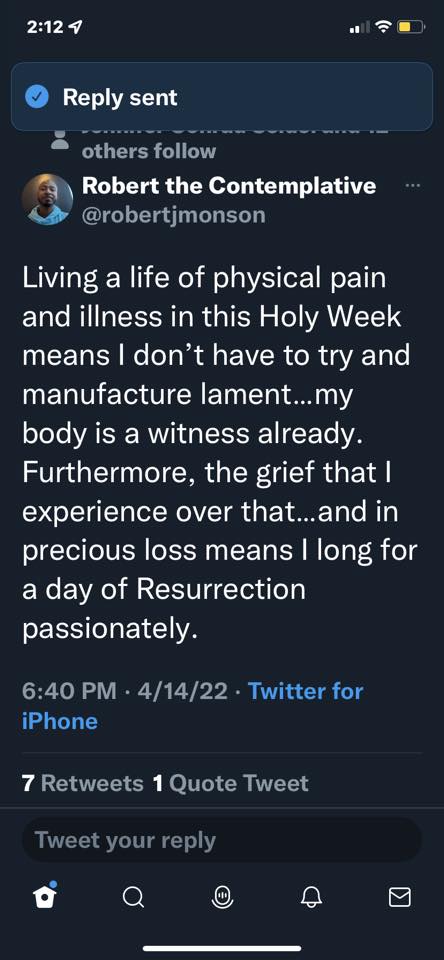
Chronic illness brings an intimate understanding of Holy Week that we don’t acknowledge. As Christ became disabled on the cross, finishing the incarnatus est, the enfleshment, the knowing what it is to be human, some of us know the pain. The pain of being nailed to a board feels an awful lot like feeling your own skeleton day in and day out. The jeering of a crowd. The audacity of an abled person saying, “me too!”. We know. We move on. We are not allowed to get tired.
Holy Week makes me long for something different. A pause on the crucifixion. Not the usual focus on the interpretation of the transaction of sin- but the crucifixion itself. The embodiment of physical pain. Jesus didn’t heal everybody- he called for crip restoration into community.
It is one thing to be on the periphery of the crip community, as a caregiver, or a loved one. It’s another thing to join it, to understand it.
Jesus experienced humiliation. The betrayal of chosen family. Friendships ending when you are at your sickest. Denial of dignity, of personhood. Nothing to help the pain but the basics. Holes in your body. Dying too early.
If that’s not a crippled Christ, I don’t know what is.
Holy Week is the week of the wait.
Lie in the sunbeam. Slow the pump. Wait for the restoration.
“At this point I cannot give you a passing grade for the work you submitted…If you get another extension you can go back and actually do the work [emphasis added]. You will need to do this today so that your [grade] does not turn into an F.”
“Yes I am aware that today’s format is not accessible, but we still planned it that way.”
I’ve never had a professor be the only thing that stood between me and my own commencement. But the final semester of my graduate studies for my mDiv, that was case. After fighting for an entire year to finish one course, I was still struggling against academic institutionalized ableism- a much more potent foe than any Greek principle part. I was a Hermione Granger at a Hogwarts for Jesus, but there was only one thing that made me different from my counterparts- I’m disabled. And at that point I was the sickest I had ever been.
Accommodations were hard to come by. My school was part of a consortium, and it turned out that neither the school nor the consortium had a disability office nor a disability officer of any kind. I had to send my private medical documentation to the Dean of Students who was also our Chaplain, who sent it to a different Dean at the consortium who had no medical training, who decided whether or not I could have what my doctor said I needed. I did not get all my accommodations approved.
It didn’t really matter in the end, because only three professors out of the twelve I had my final year-and-a-half of seminary actually followed my accommodations like they were mandated to by law. Accommodations aren’t special privileges or special treatment, they aren’t cheats. They give you a seat at the table and give you a chance to thrive the same as your peers.
When you’re deliberately made an outlier, by whatever means, it becomes more and more de-humanizing. “Stand as you’re able” isn’t inclusive when everyone stares at you trying to figure out why you can’t stand.
Professors not honoring your accommodations basically says “you are too inconvenient to me to allow you to achieve.”
So here I found myself in a class about Christian worship. Online, as many of my classes were so I could work from home and around my debilitating pain. My accommodations still applied. I was allowed to test differently, to have certain days for home care, to arrange different deadlines.
This professor was a guest professor touted for having a worship design company that travelled to different congregations to transform their worship programs. She had her own book that was required reading for our class.
A while into seminary I observed a split in the personalities amongst my female professors. There were barely two generations of them and their personalities seemed to go one of two ways- humbled and passionate about sharing knowledge, or expanded by an ego still feeling the need to compete for their place amongst men. Forgetting that time had passed, and their female students were just eager to see someone like them standing before them, that their female professors were few. That they still heard from old men telling them all the reasons they were not worthy of their vocation. That ego was getting in the way of intimacy, learning, relationship, and depth.
But if I wasn’t worshipping her deadline, her way, her technique, her business- I was failing.
When we read the books (the ones I was accused of not reading) I critiqued their lack of accessibility for worship and the ableism present.
When we presented a piece of us leading worship I taught a piece of signed liturgy- the Lord’s prayer.
And in final projects I re-wrote liturgy with instructions to make services more accessible for the disabled. Why? Because that’s why I haven’t been to church in five years.
When I went on her business website for worship design I found no accessibility, no resources for disabled congregants.
If I didn’t agree with her opinion, I was wrong- and threatened with failure. But worship doesn’t have right or wrong answers.
So this leads me to the real question- what really did I learn about worship from an ableist professor who just punished me for being disabled?
I learned from myself.
I learned that worship has nothing to do with buildings. The best worships I’ve ever been to were around campfires with tiny humans stomping their feet with reckless abandon, covered in dirt, dancing with the counselors with stars glowing overhead. Reveling in the safety of the trees, we sang for God, we sang for each other, as we bubbled up with laughter. And when fireban came we filled the firepit with twinkle lights. Worship is campfires.
Camp El Camino Pines, Frazier Park, CA (Middle photo by Tess Tait)
What is worship? Worship is using your gifts to bring joy to others. Worship is filling the halls with music, sending notes reverberating through the steeple or through Kingsmen Park. It’s walking up Mt. Clef talking to a close friend, it’s singing in the first gay Bishop in the synod. It’s choir folder #17.
Worship is listening. To yourself, to others, to God. Worship isn’t cultural appropriation for production value, only using the best in your congregation because that’s what sounds high quality. It’s not highly produced. It’s not ignoring needs for your benefit or your vision. It’s not plagiarizing your disabled student’s work during a pandemic to make yourself look better.
Worship is that snapshot moment in time with your friends on a mountain road in summer with the windows down singing to the radio, thinking I always want to remember this.
That’s how God feels about us. Worship is being fully alive in authenticity in who God made us to be.
In the hospital and then the acute rehab unit, I had been surrounded by helpers and support people. Here in person, on the phone, and in messages sent.
The day I was brought home, I couldn’t feed myself, couldn’t walk through doorways on my own, couldn’t bathe myself, and had to carry a laminated note with me at all times that told me how to find my house, and my front door if I got outside on my own.
It also told me step by step how to get the door open and how to step through it into the house. It also had an emergency number attached in case someone found me and needed to return me.
The support I had in the hospital evaporated to a skeleton crew of people the moment we arrived home. My freedom and independence suddenly cut off, my ability to have anything I could do on my own gone. I couldn’t watch tv or listen to most music or audiobooks because my brain could not keep up with it. So many days I wept until I was aching and my eyes sore. It felt like I had survived hell and arrived on the battlefield, bodies of my warrior team lying spent around me, out of energy and broken for carrying me through the valley of death and heaving me to safety.
And now I was home, and the aloneness of being in this battle was heavier than I can explain.
Often, I sat in the dark, rocking, in physical and mental anguish. So alone. I felt a little like Gollum. My precious. So overwhelmed. And my PTSD nearing nuclear levels as I tried to survive.
My mom fed me—like an infant unable to hold the spoon—every meal of every day. She slept in my room with me because I would wake not knowing who I was or where I was, and I wouldn’t recognize her. She would shhhhhhh calmly at me, talking me down the fear ledge and hold me as reality broke through the mental and drug-riddled fog that was thrashing my soul. And the reality settling on the mast of my ship on this journey was terrifying and agonizing.
I don’t know how I didn’t give up. I’ve always just been built to dig in and fight. I am thankful for my family and the close friends who took on the sudden weight of doing it all with less help.
I kept reaching out to people, trying to be included, trying to love on others, and desperately trying to explain how lonely I felt. Occasionally, a person would come by the house, but it was like one a month, if that. Even my skeleton support system became almost completely support by phone or text because LIFE.
Then Covid hit. And people all over started shouting they were suddenly so alone, so unable to bear being shut off from the world, so heartbroken to be incapable of going anywhere.
And people flocked to have visits through my glass door, front porch visits that I valued highly. And I also empathetically knew were not all really for me, but for most for them. So I gladly engaged seeing them.
A gentle prompting question, a genuine wonder, is if the visits were for me as people incline to lead, they would have happened before then, when I was crying out for anyone to hear me, and they would not have ceased when the world started to open back up and they had other places they could get their togetherness filled.
I share this to shine a light for others going through this and also to encourage my own soul. I am part of several chronic illness groups online. I have counted in heartbreak as there are at least 75 different posts a day from all different people, crying out. They say they don’t know where their friends went after their illness began, or does anyone else know how to make friends when they can’t go anywhere, or asking what it is like to have a friend in person.
A closer look at this ubiquitous phenomenon for chronically ill:
The day I went into the hospital, two of my absolute best friends didn’t show up. They never called. They never texted. They never sent a card or email. They simply were gone. Later, one told me she felt guilty for not interacting at the beginning and her guilt kept feeling bigger each day, so she walked away. This is NOT a unique experience in our world!
As the years have gone on, I have consistently reached out to people over and over yet the responses in return got less and less until I have nearly given up.
Even the social groups, like hybrid churches or clubs (half in person, half on zoom) have become so heavy to my heart to show up online because what does it mean if I have reached out to the members to be included in life during the week—as they discuss on how they DO LIFE TOGETHER during the week with hikes and movies, parties and game night, prayer sessions, music sessions, and walks, as they encourage each other and discuss they have called and talked to each other throughout the week—but only the leaders continue to make an effort to include me in this every-day life they all have together?
It hurts worse to show up online and have people tell me they were thinking of me or missed me—or worse, we’re going to call me… Again, I would challenge is that statement for me or for them to get out of the awkward moment and having to do some action as follow-up?
I have reached out with as much strength as I can, and having the strength to show up and be reminded that I am not a part of the whole is just outside my level of capability.
I have a core group of people who are still my support—but almost all of them (outside of family and chosen family) are either other disabled people or shut ins, or they are out of state or country and we communicate digitally.
To be clear, having all my bad@ss warriors who have never left me behind is AMAZING and awesome support—until there is a real life need where I need a capable, physically present IRL human. I fear reaching out to people who have slowly evaporated, because I don’t know who we are together today. I don’t know how to ask.
And in that, I do know I’m not alone.
May we encourage each other and not forget each other. May we lift each other up and remember when we are walking, not to forget those still [unable]. May we make space for each other at our tables and recognize each other rather than imagining we have done so and missing the people outside our door.
May we consciously encourage one another and imagine with fullest heart’s intent what their world must be like and how we can connect. And above all, when someone reaches out to us, may we connect with them with a full heart, giving them our entire attention for that moment and showing them they are loved, they are important, and they are not forgotten.








 Moxie
Moxie 