The story of the “bleeding woman” is found in more than one gospel and is a familiar narrative to many of us that grew up “well churched”. Feel free to read this retelling in NIV below to refresh yourself.
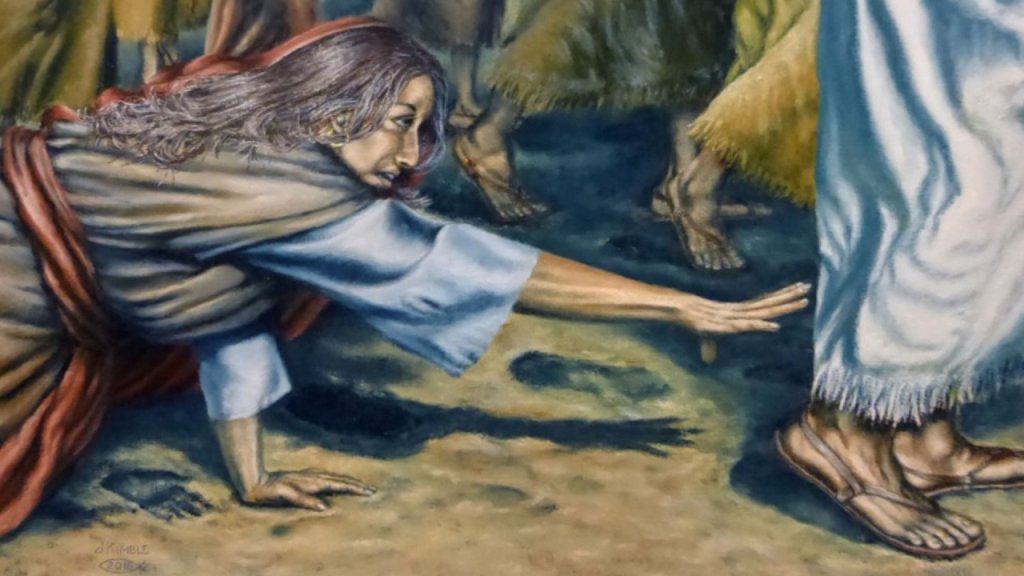
25 a woman was there who had been subject to bleeding for twelve years. 26 She had suffered a great deal under the care of many doctors and had spent all she had, yet instead of getting better she grew worse. 27 When she heard about Jesus, she came up behind him in the crowd and touched his cloak, 28 because she thought, “If I just touch his clothes, I will be healed.” 29 Immediately her bleeding stopped and she felt in her body that she was freed from her suffering.
30 At once Jesus realized that power had gone out from him. He turned around in the crowd and asked, “Who touched my clothes?”
31 “You see the people crowding against you,” his disciples answered, “and yet you can ask, ‘Who touched me?’ ”
32 But Jesus kept looking around to see who had done it. 33 Then the woman, knowing what had happened to her, came and fell at his feet and, trembling with fear, told him the whole truth. 34 He said to her, “Daughter, your faith has healed you. Go in peace and be freed from your suffering.”1
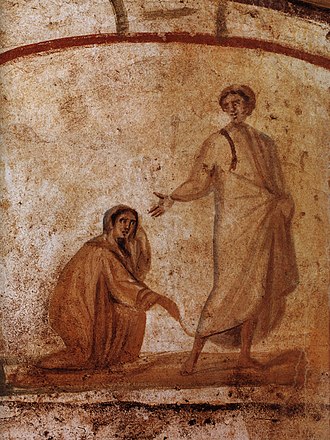
I’ve heard everything about the “bleeding woman” from being a bastion of bravery for touching the cloak, to being selfish and taking up Jesus’ time. She has, in history, been called also “the audacious woman”. Audacious indeed.
I put her moniker in quotations because the missing piece we need in interpreting her story is that she likely had endometriosis.2 There are many3 scholars who have extrapolated what was happening in the unnamed woman’s body. She likely wasn’t just bleeding, she was experiencing pain. What the story seems to emphasize is that her faith, or pistis, (which connotes perseverance and persistence as well as faith), led her to someone who could alleviate her suffering, her pain.
For twelve years she had tried whatever physician she could afford, with no yield of relief. She was still suffering twelve years later. People call her “audacious” because she interrupts Jesus, and takes what she can (according to this NIV account where Jesus describes the power going out of him.) She appears to receive healing that ends her pain, and is praised for her faith and audacity. It reminds me of the verse in Malachi that challenges us to test God, and let God pour out the blessings upon us.4
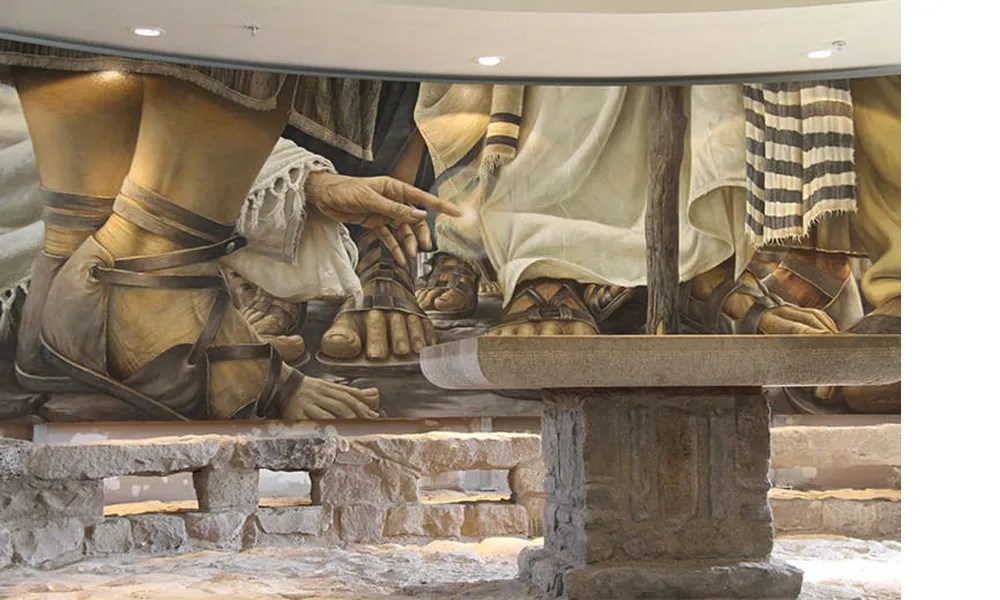
But let us not be misled by the fact that she no longer experienced pain! Never forget the persistence and utter desperation it took to touch the coat of a folk healer; at your wits’ end. I could talk about the power of human:human touch on a body that only ever gets touched clinically. I could easily go into deeper context about Greco-Roman views on bodily fluids, healing, and embodiment, but we can all relate to the human experience of desperation. Of trying one last time.
Of course, fixing of a chronic condition or disability was not the goal of Jesus. We know Jesus healed because he wanted to restore community members back to the community. Just like Jairus, his wife, and his daughter’s narrative are woven throughout this story, they unite in the goal of restorative disability justice. All the women at different stages of their life were entitled not only to restoration in the community, but their purpose and vocation. It is recorded that Jairus’ wife also held an important leadership role in the synagogue, so what did the Audacious Woman do where she was economically independent and funding her own healthcare? What was her vocation before pain intervened?5
What did you do before pain intervened?
In bereavement, there is a model called the Grief/Restoration model.6 The model states that we bounce between states of restoration and then grief, inevitably, for indiscriminate amounts of time. We could be in the restoration side trying to cultivate new things for years, months, weeks, days, hours, minutes. And the same if true for the grief phase.
I would argue that touching the cloak of Jesus brought the Audacious Woman back into the restoration phase of her life. The world and community was open to her when she no longer was experiencing chronic pain.
Does this mean that we should fix chronic pain? Or emotional pain even?
No. It doesn’t.
Grief is as essential as restoration. Both should lead us to community. Whether or not the restoration includes the end of suffering or pain. How we carry that grief, and carry it with others, matters. Transformation: optional. Transformation? Highly recommended.
Be Audacious.
- Mark 5:25-34 ↩︎
- “Woman with a Twelve-Year Hemorrhage” (pp.424-425) by Amy-Jill Levine in Women in Scripture: A Dictionary of Named and Unnamed Women in the Hebrew Bible, the Apocryphal/Deuterocanonical Books, and the New Testament, edited by Carol Meyers (2001)
↩︎ - https://www.womeninthebible.org/hemorrhaging-woman
A fairly comprehensive list on further reading of women experiencing hemorrhage (or similar) in the Bible. ↩︎ - Malachi 3:10 NLT ↩︎
- Amy-Jill Levine, “Woman with a Twelve-Year Hemorrhage”. ↩︎
- https://www.psychologytoday.com/us/blog/widows-walk/202310/the-dual-process-model-of-grief ↩︎
 Moxie
Moxie 